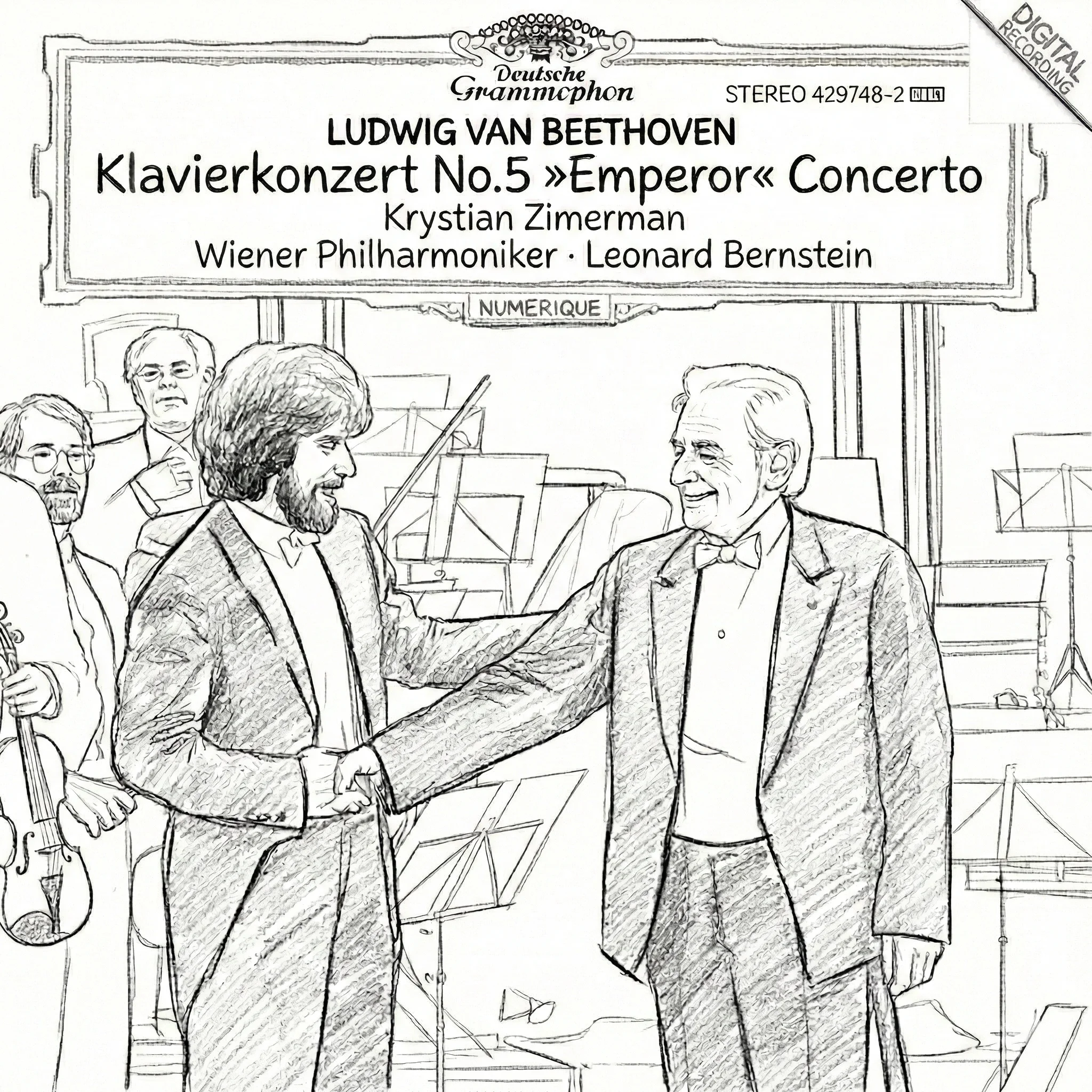
There is a particular kind of music that arrives already tinged with loss. You hear it differently when you know the circumstances — not because the notes have changed, but because the silence around them has. The 1992 Deutsche Grammophon recording of Beethoven's Piano Concerto No. 5 in E-flat major, the "Emperor," with Krystian Zimerman at the piano and Leonard Bernstein conducting the Vienna Philharmonic, is that kind of music. Bernstein died in October 1990, a year before the album reached listeners. What we have is a document of something that was ending even as it was being made.
The sessions took place in September 1989 at the Grosser Musikvereinssaal in Vienna — one of the most acoustically storied rooms in the world, its wood panels and gilded reliefs partly responsible for the warmth that the Vienna Philharmonic seems to carry in its bones. Zimerman was in his mid-thirties, a decade removed from his Chopin Competition victory and already known for the kind of perfectionism that made him one of the most selective recording artists of his generation. Bernstein was sixty-one, in the fullest and most indulgent phase of his interpretive life, wringing out every phrase until it had given up all its feeling. On paper, the collaboration might have seemed mismatched. In practice, it produced one of the defining Beethoven recordings of the late twentieth century.
What makes this "Emperor" so striking is the productive tension at its core. Zimerman's piano playing tends toward the aristocratic — crystalline, calibrated, each note placed with an almost architectural sense of purpose. Bernstein's conducting in his final years moved in the opposite direction: expansive tempi, enormous emotional swells, a sense that the music was being discovered rather than executed. In the opening Allegro, which stretches past twenty minutes in this recording — longer than many conductors would dream of holding — you can hear these two sensibilities in negotiation. Bernstein opens vast structural spaces; Zimerman fills them with playing of startling clarity and color. The result is not a compromise but a convergence, each performer drawing out something in the other that neither would have found alone.
Beethoven wrote the "Emperor" in 1809, during the French bombardment of Vienna, and the concerto has always carried that siege-like energy — the first movement's thunderous opening, the piano's solo flourishes like declarations of defiance. But the concerto's genius is in its architecture: the way that martial grandeur eventually makes room for something far more interior. The second movement, marked Adagio un poco mosso, is one of Beethoven's most quietly radical inventions — a slow, meditative song in B major, a key so distant from the home key of E-flat that the music seems to have wandered into another world entirely. In this recording, Zimerman's tone in that movement is almost impossible to describe. "Diaphanous" gets at part of it — a translucency that lets the harmonics breathe — but what lingers is something about the quality of attention he brings, as if the music were being listened to rather than performed. At over nine minutes, Bernstein's tempo is among the most unhurried on record, and it works, because at that pace the listener has no choice but to follow the music's interior logic rather than its surface drama.
The transition from the slow movement to the Rondo finale — a moment Beethoven notates with extraordinary subtlety, the piano alone softly sketching the coming theme before the orchestra crashes in — is handled here with what several critics have called a sense of wonder. That's not a word that gets used carelessly in serious music writing. But it fits. There's something genuinely tentative and then jubilant about that moment, as if both performers were rediscovering the music in real time.
The recording was produced by Hans Weber and engineered by Hans-Peter Schweigmann, whose challenge was not a small one: to balance an intimate solo instrument against one of the world's great orchestras in a room that carries sound with almost too much generosity. The solution leans toward the grand — this is not a recording that prizes delicacy above all else — but the piano is never swamped. Zimerman's cadenza in the first movement, written out by Beethoven himself in an unusual departure from convention, lands with the "perfectly weighted" clarity it demands.
It's worth noting that this recording is only half of what was planned. The collaboration between Zimerman and Bernstein was meant to document all five Beethoven piano concertos. The final three — Nos. 3, 4, and 5 — were captured in 1989. After Bernstein's death, Zimerman completed the cycle in December 1991 by conducting the Vienna Philharmonic himself from the keyboard, a remarkable act of both tribute and self-reliance. The complete set was released in 1992 as a testament to an interrupted project. The "Emperor" stands at its center not just as the most famous of the five concertos but as the record of a partnership's high-water mark.
Zimerman returned to this repertoire thirty years later, recording the complete cycle again in 2021 with Sir Simon Rattle and the London Symphony Orchestra — under pandemic conditions that meant reduced orchestral forces and physical distancing on stage. He has spoken about the similarities between Bernstein and Rattle, how both conductors seem to "become the music" rather than manage it. But the 1989 recording has something the later one cannot: the presence of Bernstein at the height of his interpretive powers, willing and able to indulge the music's every implication without apology.
There's a risk in calling any recording "definitive." Beethoven's "Emperor" has attracted extraordinary interpreters — Rudolf Serkin's wartime recording with Bruno Walter, lean and urgent; Ashkenazy's solid, purposeful account with Mehta — and each reveals something different about a piece that has more layers than most listeners initially suspect. But the Zimerman-Bernstein collaboration does something specific that the others don't: it makes the concerto feel genuinely heroic without ever becoming bombastic, and genuinely intimate without becoming small. That balance is the hardest thing in Beethoven, and it's what this recording gets right.
If you come to it fresh, start with the second movement. Not because it's the best entry point structurally, but because it will tell you immediately whether this performance is for you. If Zimerman's piano and Bernstein's slow, deliberate pulse feel like an opening rather than an indulgence, you'll want to hear everything else. And if you go back to the beginning after that — to the first movement's magnificent controlled explosion — you'll hear it differently. You'll understand what's at stake.
That's the mark of a great recording: it changes how you listen, even to the music you thought you already knew.
Leave a comment ✎