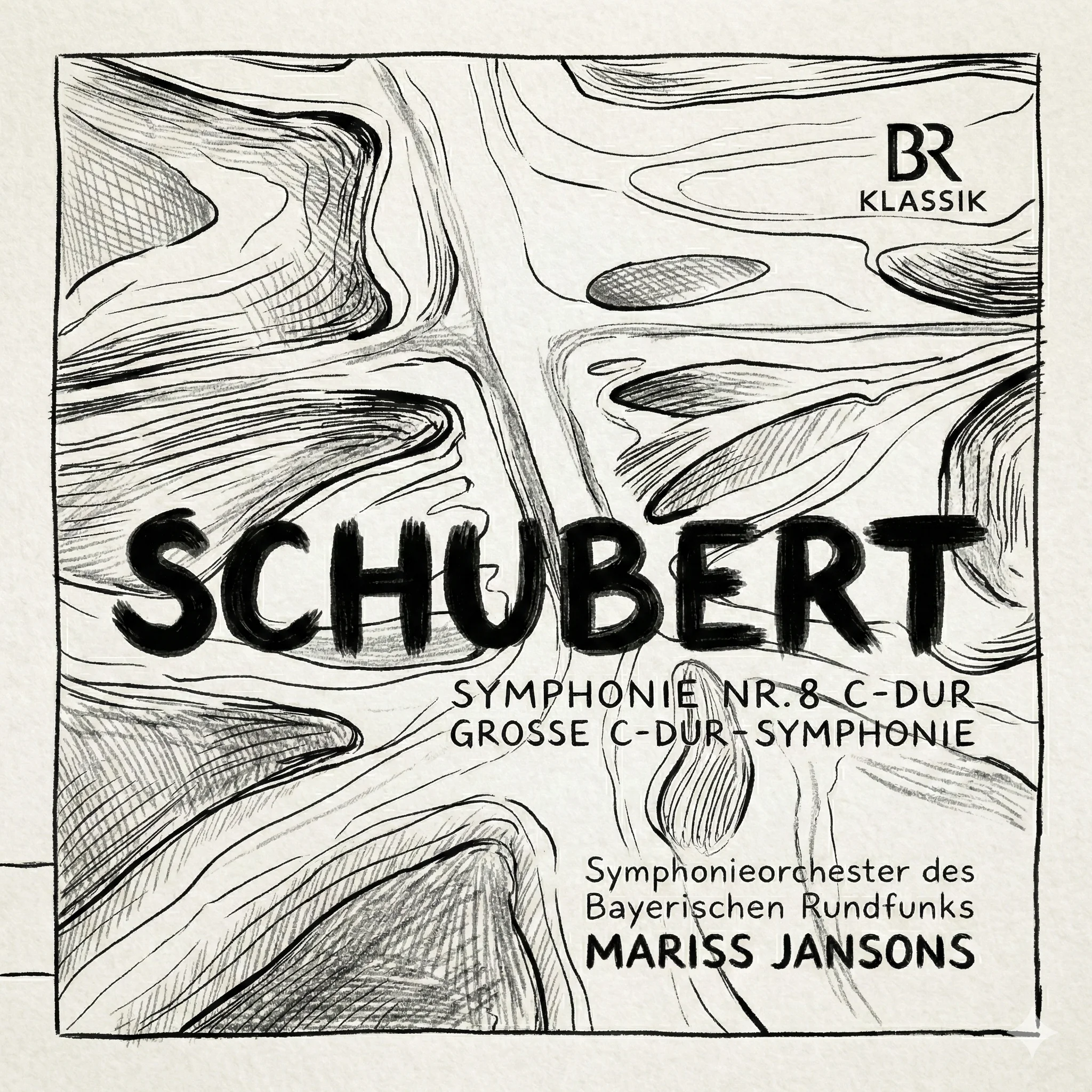
There is a particular kind of recording that arrives not merely as a new entry in the catalog but as a corrective—an argument, made quietly and without polemic, about how a piece of music should sound. The 2018 BR-KLASSIK release of Schubert's Symphony No. 9 in C major, "The Great," with Mariss Jansons conducting the Bavarian Radio Symphony Orchestra, is exactly that kind of recording. It arrived to critical acclaim, collected five-star ratings from the BBC Music Magazine and the Sunday Telegraph, and earned the admiring phrase "uncommonly fresh" from the seasoned ears at MusicWeb International. But what the reviews collectively suggested, without always saying it plainly, was that Jansons had done something genuinely difficult: he had made one of the most familiar symphonies in the repertoire sound necessary again.
To understand why that matters, it helps to know something of the symphony's strange history—a story almost too romantic to be believed. Schubert composed the bulk of the work between 1825 and 1826, during and after the longest journey of his short life. Traveling through the Austrian Alps to Bad Gastein, he encountered landscapes he described as "truly heavenly," and the symphony carries that altitude in its bones—its vastness of scale, its pastoral lyricism turning suddenly monumental. He was twenty-nine when he finished it, precisely the age at which Beethoven, his idol and impossible benchmark, had just published his first symphony. The ambition embedded in that coincidence is almost unbearable. Schubert never heard a public performance of the piece. After an informal reading by the Gesellschaft der Musikfreunde in 1826 it was shelved as too long and too difficult, and it remained largely unheard until Robert Schumann, rummaging through a pile of manuscripts at Schubert's brother Ferdinand's apartment in Vienna, stumbled upon the score in the winter of 1838–39. He immediately arranged for Felix Mendelssohn to conduct its premiere at the Leipzig Gewandhaus on March 21, 1839—eleven years after Schubert's death. Schumann's subsequent review coined the phrase "heavenly length" to describe the symphony's expansive, unhurried logic, and the phrase has stuck ever since, sometimes wielded as a compliment, sometimes as a gentle warning to the impatient.
The question every conductor must answer is: how do you justify that length? How do you persuade a modern audience that Schubert's repetitions are accumulative rather than merely circular, that the coda of the finale's 180-bar peroration is revelation rather than exhaustion? Jansons' answer, captured live on February 1 and 2, 2018, at Munich's Herkulessaal, was fundamentally rhythmic. He understood, as Toscanini had intuited decades earlier and as modern score study has since confirmed, that the symphony's opening Andante is marked alla breve—in cut time, not the slow 4/4 processional that became standard for much of the twentieth century. This single interpretive choice ramifies through everything that follows. The introduction feels lithe, purposeful; it leads somewhere rather than merely preceding something. As the movement gathers into its main Allegro, Jansons increases the tempo by stages, creating a structural integration so seamless you barely notice the join. The famous horn triplets bounce rather than lumber. The dotted rhythms in the outer movements acquire fanfare-like incisiveness. Even at the finale's most colossal moments, the orchestra never sounds as though it is straining under the weight of the music—it sounds like it is riding it.
The BRSO, which Jansons had led since 2003, responds throughout with a quality of ensemble listening that is only possible after sixteen years of collaboration. The woodwind solos in the slow movement—that walking, searching Andante con moto in A minor—emerge with the individuality of chamber music while remaining perfectly integrated into the orchestral texture. The trombones, which Schubert unusually deployed in every movement of this symphony, are present without being overbearing, a balance the Herkulessaal's "special acoustics" help to ensure. The hall is known for its clarity, and the BR-KLASSIK engineers have captured a sound that is warm and immediate without sacrificing transparency. You can hear, when you listen closely, exactly what Schubert asks of each instrument and exactly how Jansons asks it to be given.
What distinguishes this reading from the available competition—and there is formidable competition, from Karl Böhm's warmly Romantic Berliner Philharmoniker accounts of the 1960s and '70s to Nikolaus Harnoncourt's forensically alert live recording from the mid-2000s—is precisely this quality of double fidelity. Jansons is faithful both to the letter of the score (the alla breve tempo, the harmonic enrichments of the part-writing, the fleeting quotation of the "Ode to Joy" theme in the development of the finale) and to the spirit of what Schubert was attempting: a symphony that would stand alongside Beethoven's Ninth not by imitating it but by answering it, by extending the symphonic argument in a direction that would only become fully legible to listeners who could hear forward to Bruckner and Mahler. Jansons hears the work from both ends of history simultaneously, and that double hearing is what gives the performance its peculiar authority.
There is one more thing worth saying, and it requires stepping outside the purely musical frame. Mariss Jansons died in December 2019, just sixteen months after this recording was released. He was seventy-six, and he had been conducting, in his final years, with an intensity that people who worked with him describe as extraordinary, as if he understood something about the time remaining. This Schubert Ninth was among the last recordings he made with the BRSO, alongside a Mahler Ninth and a final concert at Carnegie Hall. Heard in that light, the performance takes on a weight that has nothing to do with heavenly length. It is a document of a musician who had spent decades learning how to listen to a great work, and who, when the moment came, had nothing left to prove and everything left to give. That is, in the end, the rarest kind of recording. Not perfect—no live performance is—but true, and irreplaceable.
Schubert: Symphony No. 9 in C major, D. 944 "Great" (Live). Symphonieorchester des Bayerischen Rundfunks / Mariss Jansons. BR-KLASSIK 900169. Recorded February 1–2, 2018, Herkulessaal, Munich.
Leave a comment ✎